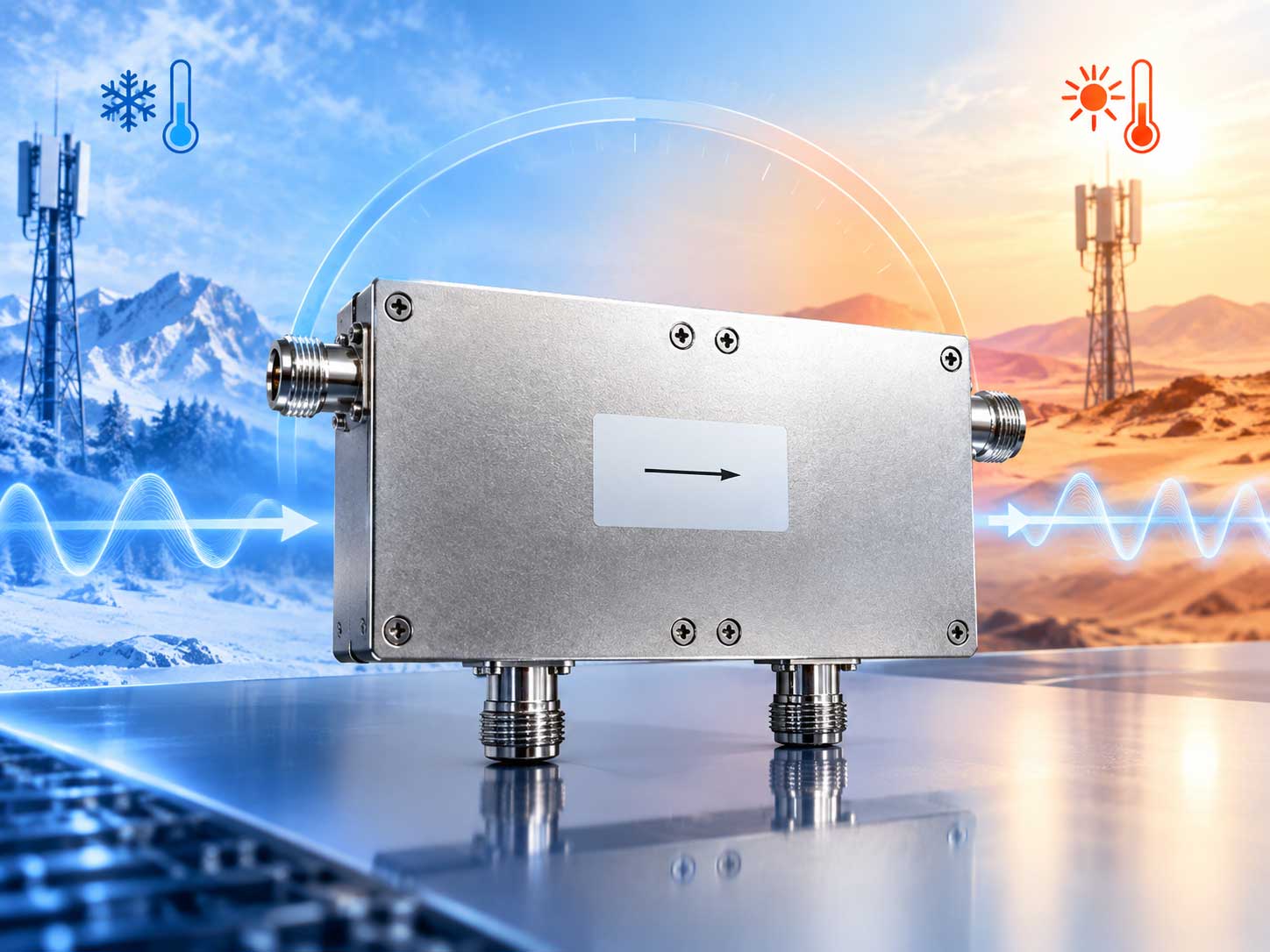
A circulator's isolation fails to hold 20dB over a wide temperature range because the ferrite's saturation magnetization (4πMs) changes with temperature. This shifts the device's operating frequency and impedance match. A circulator rated at 20dB isolation at room temperature can drop to 15dB or lower at -40°C or +85°C.
This is not a design flaw — it is the physical nature of ferrite materials. The problem is that many datasheets only provide room‑temperature data. Procurement and system engineers don't see the risk. When the equipment is installed in a northern outdoor cabinet or on a sun‑exposed rooftop in the south, reflected power destroys the power amplifier. Only then does the investigation reveal that the circulator has "de‑tuned" at extreme temperatures.
A circulator is a non‑reciprocal three‑port passive device based on ferrite material. Signals can only travel in a fixed circular direction: Port 1 → Port 2, Port 2 → Port 3, Port 3 → Port 1.
Isolation is one of the most critical specifications. It measures how much a signal entering a port in the reverse direction is attenuated. For example, a signal entering Port 2 in reverse should be routed to Port 3 (the load port), not leak out of Port 1. Isolation is the measure of this "no‑leak" capability.
In power amplifier protection, a circulator is often used as an isolator — with a 50Ω load on Port 3. The PA output connects to Port 1, the antenna to Port 2, and the load to Port 3. Power reflected from the antenna enters Port 2 and is routed to the Port 3 load, protecting the PA.
If isolation drops to 15dB, about 3.2% of reverse power leaks back to Port 1, directly hitting the PA output. At 20dB, that figure is 1%. A 3× difference in leakage power means a completely different stress level on the PA.
The saturation magnetization (4πMs) of ferrite materials has a negative temperature coefficient. As temperature rises, 4πMs decreases, and the ferrite's resonant frequency shifts.
For a typical garnet ferrite, the temperature coefficient of saturation magnetization is in the range of -1900 to -2300 ppm/°C (from -35°C to +85°C). This means a 100°C change causes 4πMs to change by about 19%–23%.
The circulator's operating frequency is directly related to 4πMs. Frequency drift causes two things simultaneously:
First, the isolation frequency response curve shifts as a whole. The isolation peak optimized at room temperature moves out of the operating band at high or low temperature. The minimum isolation in the band can drop from 20dB to below 15dB.
Second, insertion loss increases. Impedance matching is also degraded. A temperature test on a Ku‑band Y‑junction circulator showed 0.35dB insertion loss variation from 20°C to 90°C. A circulator with <1dB loss at room temperature can approach 1.35dB at 90°C.
A classic IEEE paper from 1974 provided measured data on a temperature‑stabilized circulator: over -10°C to +60°C, VSWR < 1.2, loss < 1.0dB, isolation > 20dB, bandwidth 450MHz (center frequency 1.7GHz). Note that this was a specially temperature‑compensated design, and the temperature range only went up to +60°C.
If a datasheet only says "Isolation ≥ 20dB" without specifying the temperature range and test conditions, that 20dB may be a 25°C laboratory figure.
The core of a circulator is a ferrite disc with a permanent magnet providing a bias field. As signals propagate through the ferrite, the bias field forces the signal to rotate in a specific direction (Faraday rotation), creating non‑reciprocity.
The ferrite's saturation magnetization (4πMs) determines the operating frequency:
For garnet ferrite, 4πMs decreases with rising temperature. For every 1°C increase, 4πMs drops by about 0.2%. From 25°C to 85°C, 4πMs falls by about 12%. For a circulator operating near 2GHz, this is enough to shift the isolation peak by tens of MHz.
Permanent magnets (typically neodymium‑iron‑boron, NdFeB, or samarium‑cobalt, SmCo) also have temperature coefficients.
When the magnet's magnetization decreases, the bias field applied to the ferrite weakens, again shifting the resonant frequency.
The essence of temperature compensation is to make the magnet's temperature coefficient match inversely with the ferrite's 4πMs temperature coefficient, so their drifts cancel each other out. NdFeB's -0.11%/°C and garnet ferrite's -0.19% to -0.23%/°C are both negative — a simple combination cannot cancel them.
There are two engineering solutions:
Option 1: Use a temperature‑compensating alloy (e.g., 30% nickel steel). This material has a positive temperature coefficient over a specific range. Combined with the magnet's negative coefficient, the net temperature variation of the bias field approaches zero.
Option 2: Design the magnetic circuit so the ferrite itself becomes part of the closed DC magnetic path. This way, the ferrite's 4πMs variation automatically affects the internal field, achieving self‑stabilization.
First, check the temperature annotation on the datasheet. If it only says "Isolation ≥ 20dB" without a temperature range, ask the supplier for a full‑temperature test report.
Second, check the magnet type. NdFeB is cheap but has a large temperature coefficient; SmCo is more expensive but far more stable. For outdoor or wide‑temperature applications, choose circulators with SmCo magnets.
Third, check whether temperature compensation is designed in. Temperature‑compensating steel, closed magnetic circuit design — these are not "optional features"; they are necessities for wide‑temperature scenarios.
Passing at room temperature does not mean passing over temperature. Full‑temperature PIM and isolation testing must be performed in a thermal chamber: hold at -40°C for 30 minutes, measure isolation; hold at +85°C for 30 minutes, measure again. The lowest isolation at both extremes is the true value.
Maniron's circulator product line covers multiple bands from VHF to UHF. Taking the 600‑700MHz coaxial circulator as an example, the nominal insertion loss is ≤0.35dB, VSWR ≤1.2, and isolation ≥22dB. The VHF 150‑174MHz model has isolation ≥15dB and an operating temperature of -30°C to +70°C.
These specification differences reflect an engineering reality: isolation specifications themselves vary across frequency bands and power levels. Low‑frequency VHF circulators inherently have lower isolation than UHF models. Do not apply a single "20dB" standard across all bands.
Scenario 1: Indoor climate‑controlled cabinet. Room‑temperature isolation is sufficient; no need to worry about temperature drift.
Scenario 2: Outdoor cabinet (with thermal control). Operating temperature range around -20°C to +55°C. Confirm the minimum isolation over this range. NdFeB magnets with temperature‑compensating steel are usually adequate.
Scenario 3: Outdoor cabinet without thermal control. Temperature may reach -40°C to +75°C. Must choose circulators with SmCo magnets and require full‑temperature test data from the supplier.
Scenario 4: Power amplifier protection. Isolation directly affects PA safety. Leave sufficient margin: the minimum isolation of a 20dB circulator over its actual operating temperature range should not fall below 18dB. If the minimum is only 15dB, the leakage ratio rises from 1% to 3.2%, a substantial long‑term reliability risk for the PA.
Q1: Why does circulator isolation change with temperature?
The saturation magnetization (4πMs) of ferrite has a negative temperature coefficient, and the permanent magnet's magnetization also varies with temperature. Together, they shift the device's resonant frequency, moving the isolation peak out of the operating band.
Q2: How much impact does a drop from 20dB to 15dB isolation have?
At 20dB, 1% of reverse power leaks back. At 15dB, 3.2% leaks back. In PA protection, a 3× increase in leakage power significantly raises the reflected stress on the amplifier.
Q3: How do I know if the 20dB in a datasheet is a room‑temperature figure?
If the datasheet does not specify a temperature range, it is room‑temperature (25°C) data by default. For wide‑temperature applications, you must request a full‑temperature test report.
Q4: How is SmCo better than NdFeB?
SmCo has a temperature coefficient of about -0.03%/°C, much smaller than NdFeB's -0.11%/°C. Over -40°C to +85°C, SmCo's magnetization change is smaller, and isolation drift is more controllable.
Q5: How does temperature‑compensating steel work?
Temperature‑compensating steel (e.g., 30% nickel steel) has a positive temperature coefficient over a specific range. Combined with the magnet's negative coefficient, the net temperature variation of the bias field approaches zero.
Q6: How wide a temperature range can Maniron circulators handle?
Maniron VHF circulators are nominally rated for -30°C to +70°C. Wide‑temperature requirements can be met through OEM customization, using SmCo magnets and temperature‑compensated magnetic circuit design.
Tags :
هل لديك أي أسئلة ؟
اتصل بنا : +86 551 65329702