What Is a 4x4 Hybrid Combiner and Why Does It Matter?
A 4x4 hybrid combiner is a passive RF device that evenly distributes a signal from any of its four input ports to all four output ports, while maintaining high isolation between ports. Think of it as a signal router that takes whatever goes into one port and splits it equally (with a 6dB theoretical loss) to all four outputs, but prevents signals from different inputs from interfering with each other.
Technically, a hybrid is a four‑port directional coupler with a ‑3dB coupling coefficient. The 4x4 version is essentially a matrix of hybrid couplers arranged so that signals applied to any of the four inputs are split equally between all four outputs. This configuration ensures that any two input ports are isolated from each other, meaning signals from different sources don't interact.
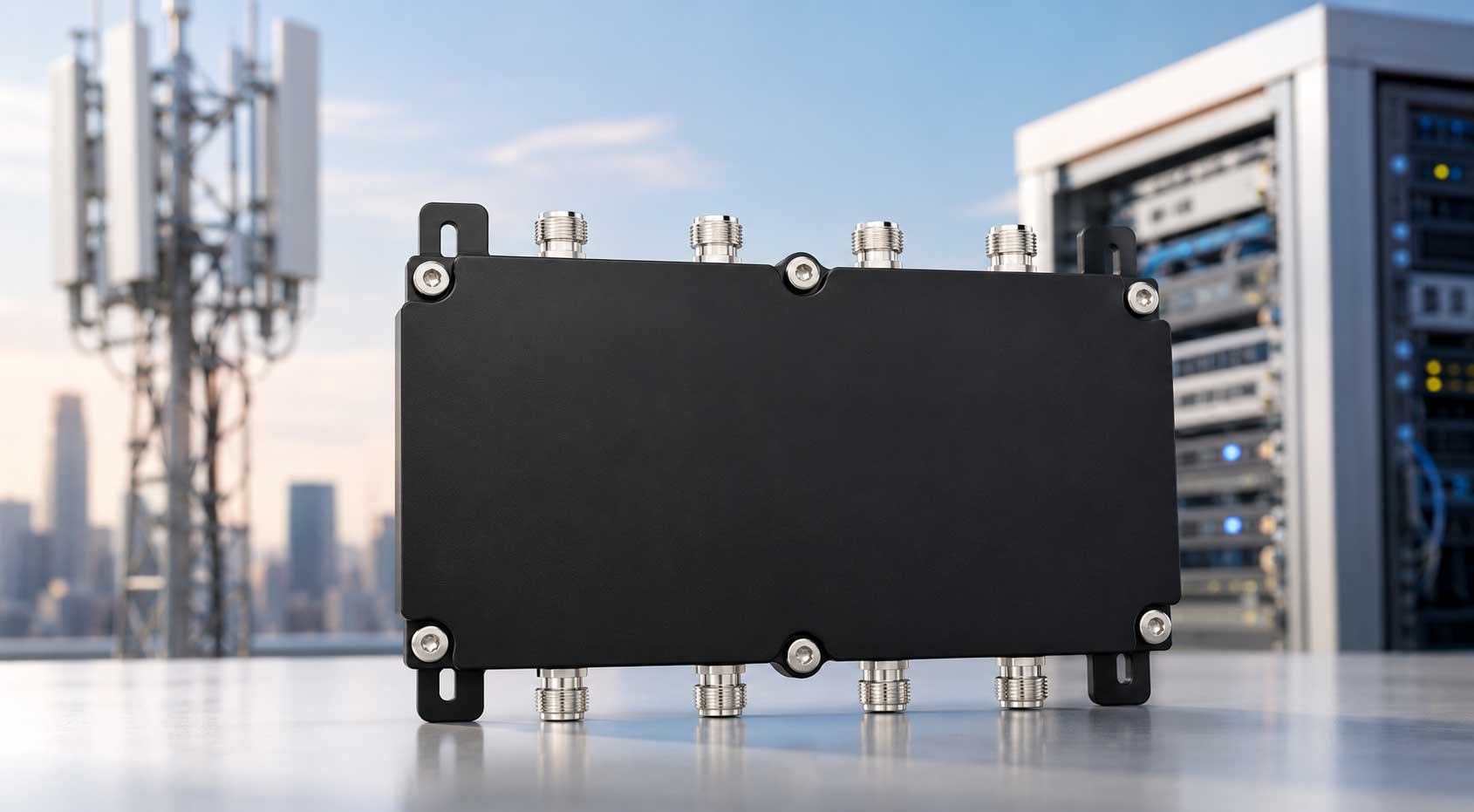
The Maniron 698‑2700MHz 4x4 Hybrid Combiner (model MHC‑727‑44‑NF‑155) covers all major mobile bands from 2G through 4G/LTE, with a low PIM rating of ‑160dBc and a power handling capacity of 200W, making it a robust choice for demanding indoor radio systems.
Key Specifications at a Glance
|
Parameter
|
Value
|
|
Frequency Range
|
698 ‑ 2700 MHz
|
|
Insertion Loss
|
6.1 ± 1.4 dB
|
|
Isolation
|
≥ 22 dB
|
|
VSWR
|
≤ 1.30
|
|
Average Power
|
200W
|
|
Impedance
|
50Ω
|
|
Connector Type
|
N‑Female
|
|
PIM Rating
|
‑160 dBc
|
|
Operating Temp
|
‑40°C ~ +65°C
|
|
Application
|
Indoor
|
The device is built with N‑female connectors, delivering steady RF performance with low VSWR and reliable power capacity, compatible with most UHF radio devices for quick installation.
How a 4x4 Hybrid Combiner Works
The Matrix Inside
A 4x4 hybrid combiner is constructed from multiple 3dB hybrids arranged in a matrix. Each 3dB hybrid splits an input signal into two equal outputs with a 90‑degree phase shift. By cascading these in a specific pattern, the 4x4 matrix achieves uniform power distribution from any input to all outputs, with each output receiving approximately one‑quarter of the input power.
Critical Operating Principles
For non‑coherent signals being combined, a hybrid does not try to dissipate the differential combining energy as heat. Instead, it routes the energy to the isolated port, where an external high‑power termination can dissipate it. This makes hybrids particularly suitable for combining multiple non‑coherent signals in DAS applications.
Port Isolation and Signal Integrity
The ≥22dB isolation between ports means crosstalk is blocked, preventing mutual interference of different signal sources and keeping the whole communication system stable. This is crucial in multi‑operator environments where signals from different carriers share the same infrastructure.
Why Choose a Hybrid Combiner for Your DAS?
Signal Combining Flexibility
A 4x4 hybrid combiner allows combining of multiple signals in the same wireless band to a common feeder cable, as might be required in a neutral host in‑building distributed antenna system. In a DAS, this architecture allows multiple base stations or signal sources to share the same antenna infrastructure efficiently.
Low PIM Performance
The ‑160dBc PIM rating is particularly valuable in 5G and high‑density networks where even small intermodulation products can cause significant uplink desensitization.
Power Handling
With 200W average power handling per port, the Maniron 4x4 hybrid combiner is capable of handling high‑power signals typical in base station and DAS applications.
Practical Considerations for Engineers
What About Unused Ports?
Unused output ports must be terminated externally with a 50Ω load featuring appropriate PIM performance. Leaving a port unterminated will cause reflections that degrade system performance.
Phase Relationships
Note that in some 4x4 designs, the phase relationship of the outputs may not be consistent across all frequencies, although special attention is directed to maximize isolation in the wireless bands and minimize PIM.
Temperature Range and Environment
The ‑40°C to +65°C operating temperature range makes the Maniron hybrid suitable for a wide variety of installation environments, from temperature‑controlled equipment rooms to outdoor enclosures.
Specifications Deep Dive
Insertion Loss: 6.1 ± 1.4 dB
This is the power loss when the signal passes through the device. In a 4x4 splitter, the theoretical split loss is 6dB (since power is divided four ways), so the measured 6.1dB indicates very low resistive losses in the hybrid network.
Isolation ≥ 22 dB
This ensures that signals from different input ports don't leak into each other. In multi‑operator scenarios, this isolation is critical to prevent cross‑interference.
VSWR ≤ 1.30
A low VSWR ensures good impedance matching, reducing reflections that could otherwise degrade signal quality and cause network instability.
PIM Rating ‑160 dBc
This is an exceptionally low PIM specification, meaning the device itself generates minimal intermodulation products when subjected to high‑power multi‑band signals. For context, a ‑160dBc PIM rating is typical for high‑performance DAS components and is significantly better than the ‑150dBc often seen in standard products.
Applications
The 698‑2700MHz frequency range covers all major cellular bands:
-
698‑960 MHz: 2G/3G lower bands
-
1710‑2170 MHz: 3G/4G mid bands
-
2300‑2700 MHz: 4G LTE bands (B7, B38, B40, B41)
This broad range makes the hybrid ideal for:
-
In‑building DAS systems
-
Multi‑operator neutral host networks
-
2G/3G/4G/LTE coverage solutions
-
Indoor radio communication solutions where multiple signal sources must be combined and distributed
Maniron's Engineering Approach
Maniron has been a leading manufacturer of RF components since 2002, with a focus on low‑PIM passive components for DAS and indoor coverage systems. Their hybrid combiners feature:
-
Wideband operation from 698‑2700MHz in a single compact package
-
Low PIM at ‑160dBc, enabling use in 5G and other high‑density networks
-
High isolation ≥22dB to ensure multi‑operator compatibility
-
Robust construction for indoor or outdoor deployment
-
Various connector options including N‑female
Related Product Variations
Maniron offers a comprehensive range of hybrid combiners in different configurations:
|
Configuration
|
Typical Use
|
|
2x2 Hybrid Combiner
|
Two‑source combining
|
|
4x4 Hybrid Combiner (this model)
|
Four‑source combining with four outputs
|
|
4x1 Hybrid Combiner
|
Four sources to one output
|
|
4x2 Hybrid Combiner
|
Four sources to two outputs
|
Each variation is designed for specific DAS architectures and is available with connector options including N‑female, 4.3‑10, and 7‑16 DIN.
A Note on Selection
When choosing a 4x4 hybrid combiner, focus on:
-
Frequency range covering all bands your system will support
-
PIM performance commensurate with your network requirements
-
Power handling meeting or exceeding your maximum expected levels
-
Connector type matching your existing infrastructure
-
Environmental rating suitable for your installation location (indoor/outdoor)
The Maniron 4x4 Hybrid Combiner offers a practical balance of all these factors: 698‑2700MHz coverage, ‑160dBc PIM, 200W power handling, N‑female connectors, and a wide temperature range suitable for most installation environments.